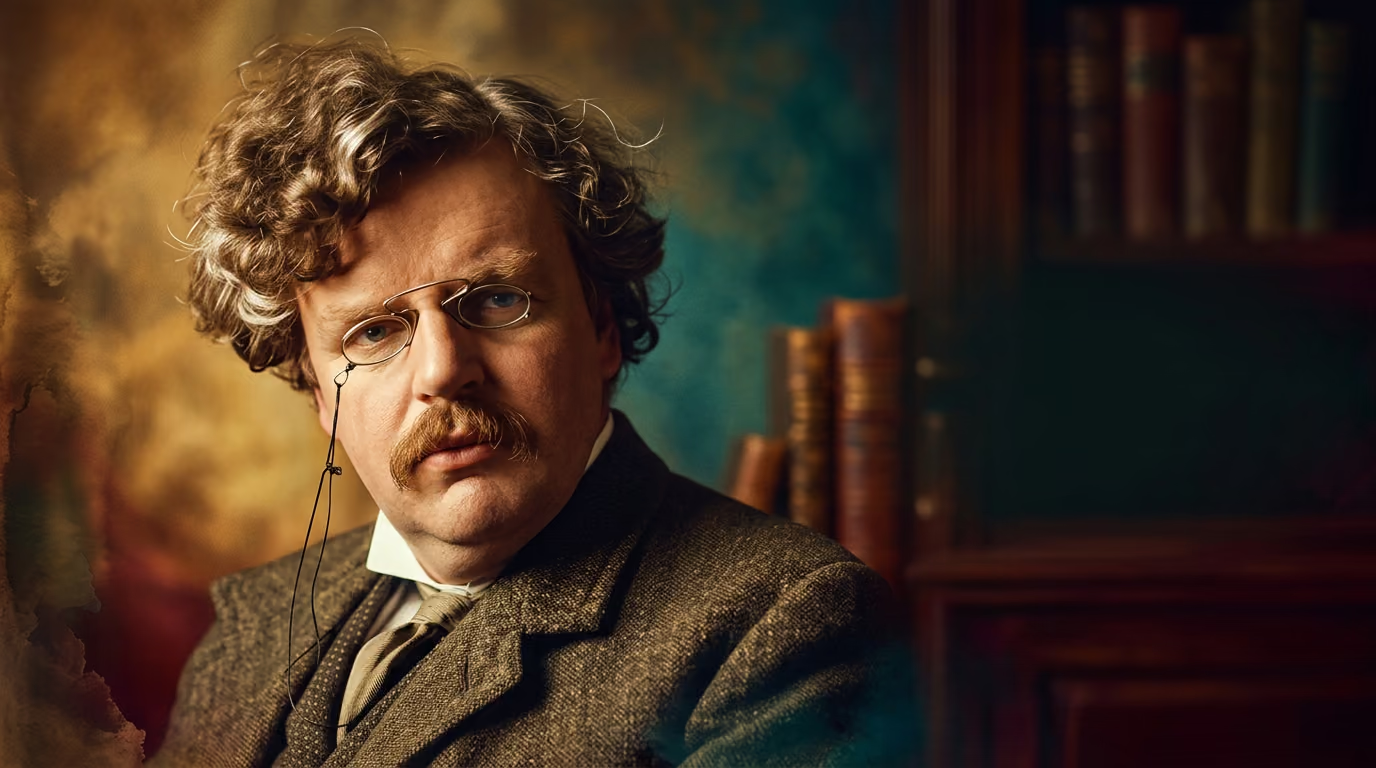
Artistic illustration of G. K. Chesterton
1874 – 1936 · Writer, journalist, thinker
Who Was G. K. Chesterton? His Life, Thought and Enduring Influence
Explore the life, world and central ideas of G. K. Chesterton — and discover José R. Ayllón’s concise new biography of the man behind them.
Who Was G. K. Chesterton?
Gilbert Keith Chesterton (1874–1936) was an English writer, journalist, critic, debater and Christian thinker. Across a working life spent largely in print, he produced fiction, essays, poetry, literary criticism, biographies and detective stories, moving between forms with unusual ease. He is particularly associated with the Father Brown stories and with works including Orthodoxy and The Everlasting Man. His writing is recognised for its humour, its use of paradox, its defence of reason and its close attention to ordinary life.
José R. Ayllón’s biography The Man Who Was Chesterton introduces this figure to English-speaking readers in a single concise volume.
Chesterton at a Glance
- Full name
- Gilbert Keith Chesterton
- Born
- 1874
- Died
- 1936
- Nationality
- English
- Known for
- Essays, journalism, fiction, poetry, biography and Christian apologetics
- Notable works
- Orthodoxy, The Everlasting Man and the Father Brown stories
- Recurring themes
- Common sense, paradox, Christianity, family, history, freedom and social criticism
Part One
G. K. Chesterton’s Life and World
Chesterton was born in 1874 and died in 1936. That span reaches from late Victorian Britain, through the Edwardian years, into the First World War and the unsettled decade that followed it. It was a period in which questions about religion, politics and the shape of industrial society were argued over openly, at length, and mostly in print.
Journalism was his trade. He worked in and around Fleet Street, writing to deadline for a general readership rather than for specialists — a habit that marks almost everything he published. The arguments of the day reached him as columns to be answered, and he answered them in the same form.
He also argued in person. Public debate was part of the literary life of the time, and Chesterton took part in it, notably against Bernard Shaw and H. G. Wells. Alongside those exchanges stood his friendship with Hilaire Belloc and his marriage to Frances Blogg. Ayllón’s first part follows all of this, together with Chesterton’s journeys to Palestine and the United States.
Part One of Ayllón’s biography: His Life, His World
Covered in this part
Frances Blogg
His marriage.
Hilaire Belloc
A close friend and fellow writer.
Bernard Shaw
A familiar opponent in public argument.
H. G. Wells
Another of his well-known interlocutors.
Fleet Street
The London newspaper world he worked in.
The First World War
The conflict that divided his lifetime in two.
Journalism
His profession, and the setting for much of his output.
Public debate
Argument conducted in halls and in print.
Palestine and the United States
The journeys followed in the first part of the book.
Part Two
What Did G. K. Chesterton Believe?
The second part of The Man Who Was Chesterton turns from the life to the ideas. Ayllón presents Chesterton’s intellectual and religious concerns as a connected whole rather than a list of opinions, and introduces readers to the subjects he returned to across his work.
Each of the themes below is one the biography takes up in turn.
From agnosticism towards Catholicism
Ayllón traces the movement of Chesterton’s religious position over the course of his life.
Christianity and reason
The biography considers how Chesterton set faith and rational argument alongside one another.
Family and marriage
The book explores the place these held in his writing about society.
Women and social change
Ayllón presents Chesterton’s engagement with the social changes of his period.
Socialism, capitalism and distributism
The biography sets out his economic arguments and the alternative he favoured.
Marx, Comte and Nietzsche
The book examines the thinkers Chesterton wrote against.
His interpretation of history
Ayllón presents the way Chesterton read the past.
His view of the Middle Ages
The biography considers a period Chesterton returned to repeatedly.
Saint Francis and Saint Thomas Aquinas
The two figures Chesterton wrote biographies of, discussed in the book’s second part.
Part Two of Ayllón’s biography: His Thought
Reading him now
Why Does Chesterton Still Matter?
Any honest answer has to begin with a qualification. Chesterton was a working journalist, and a great deal of what he wrote was addressed to the controversies of his own decade — controversies that have since closed. Those pages are historical documents now, and read as such.
What carries beyond that context is a manner of thinking rather than a fixed set of conclusions. Three features of his writing still give a reader something to work with.
A defence of reason
Chesterton argued rather than asserted. Readers who disagree with his conclusions can still follow the reasoning that produced them.
Paradox as a tool
The reversal of an expected phrase was his characteristic device — a way of making a familiar idea unfamiliar long enough to be examined again.
Attention to ordinary life
Family, work, streets, meals and habits are treated as serious subjects rather than as background to more important ones.
None of this makes him a comfortable author, and none of it settles whether he was right. Ayllón’s biography does not attempt that verdict. It sets out what Chesterton thought, where the thinking came from, and the world it was addressed to — and leaves the judgement to the reader.
The book
A Concise Introduction to Chesterton’s Life and Thought

The Man Who Was Chesterton is a concise biography that introduces readers to Chesterton’s life, historical world and central ideas.
Its first part follows his life, friendships, journalism, public controversies and journeys. Its second part examines his religious, historical and social thought.
Edition details
- Title
- The Man Who Was Chesterton
- Author
- José R. Ayllón
- Translator
- Aurora Rice
- Publisher
- Arouca Press
- Publication date
- 13 April 2026
- ISBN
- 978-1-998492-81-7
- Pages
- 198
- Language
- English
- Format
- Paperback
Availability, prices and delivery options may vary by country and retailer.
Readership
Who Is This Biography For?
A short book with a defined purpose. It will suit some readers better than others.
- Readers discovering Chesterton for the first time
- Readers seeking a concise biography
- People interested in Chesterton’s life and central ideas
- Readers interested in Christian thought, history and social criticism
- Existing Chesterton readers looking for a perspective from the Spanish-speaking world

The author
About José R. Ayllón
José R. Ayllón is a Spanish philosopher, teacher and writer. He studied Philosophy and Literature at the University of Oviedo and Bioethics at the University of Valladolid.
He has taught in secondary education and at universities including Navarra, Montevideo and Universidad Panamericana. His books include works on ethics, history, education, philosophy and notable historical figures.
Watch
José R. Ayllón Speaks About Chesterton
This Spanish-language video contains excerpts from a talk about Chesterton featuring José R. Ayllón.
More on YouTube
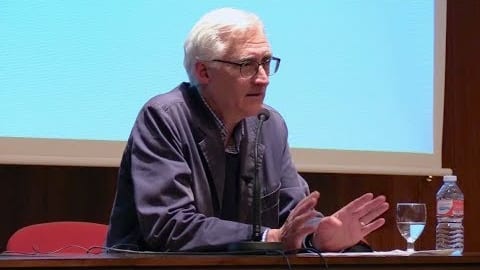
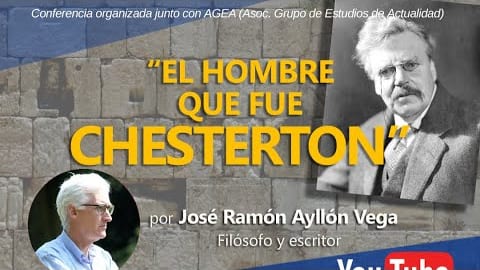


These two recordings open directly on YouTube. Nothing is loaded from YouTube on this page until you choose to play the featured video above.
Editorial transparency
This website is an informational companion to “The Man Who Was Chesterton” and has been created with the author’s authorization. It contains links to retailers where the book can be purchased.
References
Sources and Further Reading
Reference sources are listed separately from the links where the book can be purchased.
Biographical and reference sources
- The Society of Gilbert Keith ChestertonA society dedicated to Chesterton and his work.chesterton.org(opens in a new tab)
- José R. Ayllón — official author websiteThe author’s own site, with information about his books.jrayllon.com(opens in a new tab)
- Arouca Press — official publisher pageThe publisher’s page for this edition, with its bibliographic details.aroucapress.com(opens in a new tab)
Where to buy the book
These are retail links, not reference sources.
Availability, prices and delivery options may vary by country and retailer.
Discover Chesterton Through His Life, World and Thought
José R. Ayllón’s biography offers English-speaking readers a concise route into the life and ideas of one of the twentieth century’s most distinctive writers.